
Lesson 01/2026
The Day I Realized I Wasn't Ready
Learning doesn't stop when you get the job.
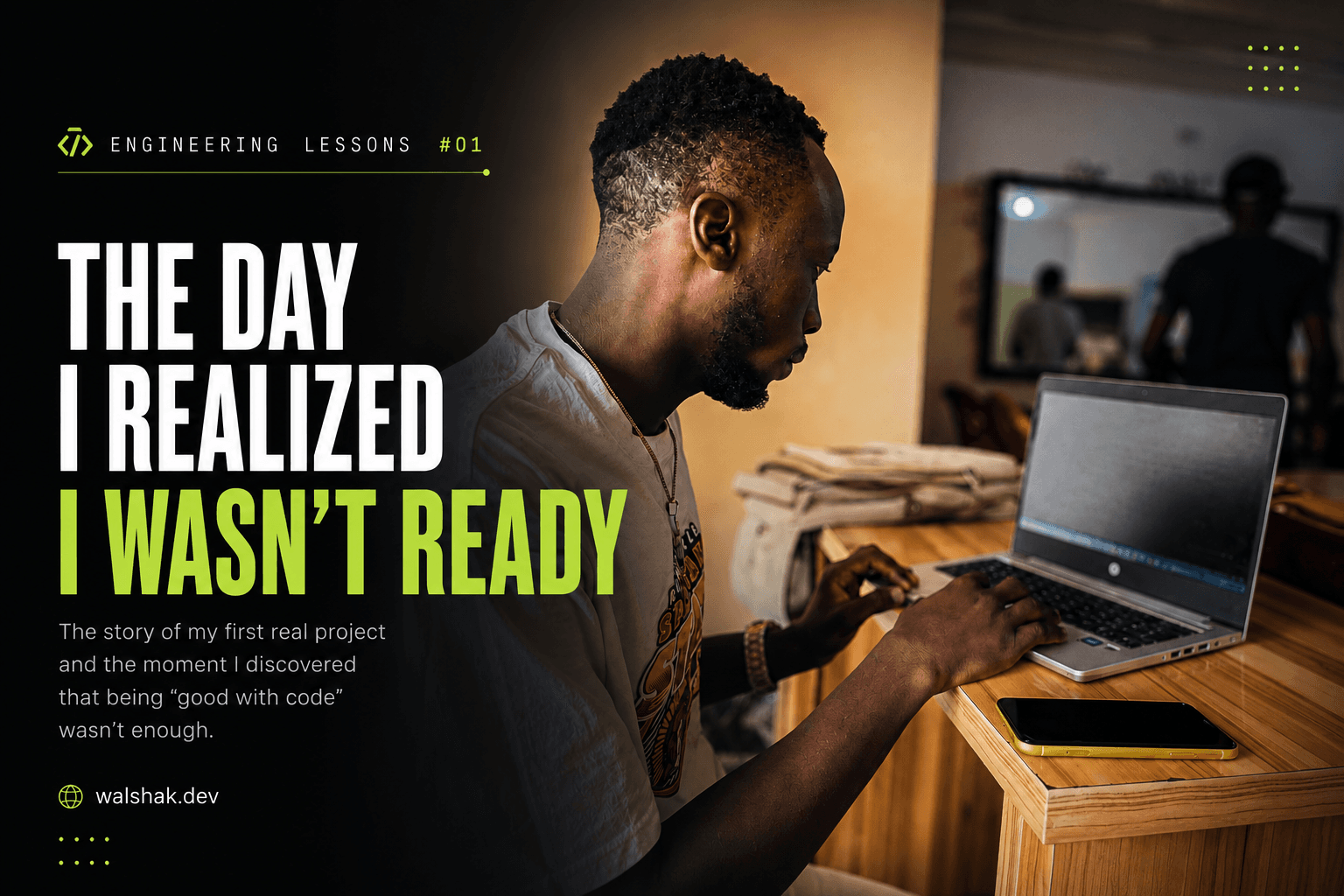
I thought getting my first software engineering internship meant I was ready.
It didn't.
If anything, it exposed just how much I still had to learn.
Three days before Christmas in 2024, I received an email from Belsoft Systems offering me a Frontend Engineering Internship. I read it more than once before it finally sank in.
I had done it.
After years of learning on my own, joining bootcamps, building personal projects, and writing code whenever I had the chance, I finally had an opportunity to prove myself in a real engineering team.
I was excited.I was grateful.And, without realizing it, I had made a dangerous assumption.
I thought getting the opportunity meant I was ready for it.
The truth is, my journey into software engineering looked nothing like a traditional one.
I studied Building Construction, not Computer Science.
My journey started during the COVID-19 lockdown after I saw someone post on X that they had just written their first line of JavaScript. Out of curiosity, I sent them a message. They replied with a link to about 1.5GB of Coursera tutorials. I downloaded them without knowing that one message would completely change the direction of my life.
Over the next few years, I kept learning. I joined Code Plateau, later moved to nHub to deepen my JavaScript knowledge, enrolled in 3MTT, and during my NYSC year in Katsina, I carried my laptop everywhere. I taught Basic Technology during the day, then came home and continued learning at night. That was where another corps member introduced me to Next.js, and I spent my evenings building projects like a marketing website for Mstack Solutions and a prototype attendance system for our CDS.
Looking back, every stage prepared me for what came next—just not in the way I expected.
Belsoft was my first remote engineering role, my first startup, and my first experience building software with a real engineering team. There were four frontend interns. We had standups every Monday, Wednesday, and Friday. There wasn't a long period to ease into things. You learned by building.
That excited me.It also intimidated me.
At that point, my understanding of frontend development was still narrow. If you handed me a Figma design, I could turn it into code. I thought that was frontend development. I hadn't yet experienced integrating APIs, collaborating with backend engineers, or thinking beyond the interface.
Then our team lead introduced the project.
It was an e-commerce application.
I was responsible for building the checkout flow.
Then he said something that instantly made me nervous:
"We'll be using TypeScript."
I had never written TypeScript before.
The meeting ended.
I didn't open VS Code.
I opened YouTube.
I searched one question:
"What is TypeScript?"
The project was starting in three days. Those three days weren't for learning TypeScript—they were simply the time left before real work began.
After watching a few videos, I realized TypeScript wasn't a completely different language. It was JavaScript with an additional type system.
I knew I couldn't become comfortable with TypeScript before the project started, so I made a practical decision. I'd build the checkout flow in JavaScript first, then use AI to convert it into TypeScript, comparing both versions line by line to understand every change.
AI wasn't replacing my learning.
It was accelerating it.
That became my study method.
Build.Compare.Read.Ask questions.Repeat.
Little by little, TypeScript stopped looking unfamiliar—not because I had memorized it, but because I was using it.
When I completed the checkout flow, my team lead reviewed it. Watching the flow work from start to finish changed something inside me.
For the first time since joining the company, I stopped asking myself whether I belonged there.
Instead, I started asking:
"What's the next thing I need to learn?"
Looking back, TypeScript was never the lesson.
The lesson was that getting the job didn't mean I had finished learning.
It meant my real engineering education had just begun.
Growth begins the moment you're willing to admit what you don't know—and then do the work to close that gap.
Belsoft didn't hire someone who knew everything.
It hired someone willing to keep learning.
I've come to believe that's one of the most valuable qualities an engineer can have.
Share this lesson

About the author
Walshak Manasseh
Frontend developer and product-minded engineer writing about the lessons behind the work.
Continue reading
Related lessons
Nobody Was Watching
Read lesson
The Internship Wasn't the Hard Part
Coming soon